Telehealth moved from a convenience to a core part of mental health care in only a few years. What began as a workaround has matured into a robust treatment environment with its own best practices and strengths. Trauma therapy, once assumed to require in-person presence, has adapted especially well. Clinicians now deliver structured approaches like CBT therapy and IFS therapy online, and faster-acting methods such as accelerated resolution therapy can be administered in a living room rather than a clinic. The benefits are real, but so are the pitfalls. The difference between an effective remote session and a frustrating one often comes down to preparation, structure, and a therapist’s judgment about fit.
What telehealth changes when the work is trauma
Trauma therapy has always balanced two priorities: safety and change. Telehealth disrupts the room, which forces both client and therapist to engineer those priorities differently.
Safety first means a clear plan. The therapist cannot knock on the door if a client dissociates or goes silent, and a shaky Wi-Fi connection can escalate a vulnerable moment. A thought-out protocol protects engagement and reduces risk: confirmed location at the start of every session, emergency contacts verified and stored, plans for network outages, and consent that covers situations unique to remote care.
Change comes from the same therapeutic mechanisms as in person, but the levers differ. Many clients actually regulate better at home. Their favorite blanket https://israelkqka075.trexgame.net/cbt-therapy-vs-ifs-therapy-which-approach-fits-your-healing-style-1 and their pet’s breathing become resources. Others need the boundary of a neutral office. The therapist has to listen for subtle signals that the home environment is intruding: a client whispering so a roommate will not hear, eyes scanning the doorway, or a client avoiding deep work because a partner returns in 20 minutes. The ability to pause and renegotiate structure becomes part of the therapy.
A quick map of trauma-focused modalities online
CBT therapy translates smoothly to telehealth because its structure is portable. The therapist can screen-share worksheets, monitor behavioral experiments between sessions, and use chat to capture coping statements. For trauma, cognitive processing and exposure variants of CBT remain effective online, provided the therapist tailors the pace and homework to the client’s environment. One practice detail: virtual exposure asks for added consent and context. When a client practices driving exposure in a parked car with a phone connection, the therapist’s contingency plan must be explicit.
IFS therapy works well in telehealth because it emphasizes internal focus. Many clients find it easier to turn inward at home. The therapist’s careful pacing and attention to blended parts becomes even more important when interruptions occur. When the screen freezes, the therapist should hold the relational thread: name what happened, re-anchor, and check whether a part took advantage of the break to retreat or flood.
EMDR has validated telehealth adaptations for bilateral stimulation using eye movements on screen or alternating tones through headphones. The same principles apply to accelerated resolution therapy, which also uses sets of eye movements while guiding imagery to change the emotional charge of distressing memories. ART stands out for its brevity and structured reconsolidation approach, and it has found a natural fit online.
What accelerated resolution therapy is, and what it is not
Accelerated resolution therapy is a brief, directive, imaginal technique that pairs sets of lateral eye movements with guided visualization. The clinician supports the client in accessing a traumatic memory while staying in dual awareness, then facilitates changes in imagery that shift how the brain stores the memory. Clients keep the facts but can lose the body-level charge, the looping images, and the intrusive sensory fragments.
ART is not casual positive thinking and it is not hypnosis. The therapist actively tracks arousal, paces the sets, and introduces technical steps that reduce symptom intensity. Typical ART work runs between one and five sessions for a discrete target, although complex trauma may require multiple targets and preparatory stabilization. Published studies to date number in the dozens, with sample sizes in the tens to low hundreds, and show promising reductions in PTSD, depression, and anxiety symptoms compared with waitlist or supportive interventions. The evidence base is still growing, but in practice, many clinicians see meaningful change within a small number of sessions, especially on focal problems like a car crash image, a specific assault, or recurrent nightmares.
Why ART has a home in telehealth
The eye movements can be cued on video with the therapist’s hand or a dot moving across the screen. More importantly, ART’s structure lends itself to a stable flow that survives the minor frictions of remote care. Once the therapist and client agree on a target image and a steady rhythm, the session feels like a track that both can return to after a hiccup.
Clients appreciate the privacy. Many prefer to process trauma in their own space and then rest immediately, not drive through traffic with dilated pupils and a vulnerable nervous system. For clients in rural areas or those who face stigma about attending therapy, telehealth removes friction. In practice, I have watched clients complete a high-intensity memory set at home, then step into a short ritual after the session: tea, a walk, or a shower. The smoother runway often reduces post-session rebound.
Preparing the tele-session environment
A trauma session rises or falls on the environment. Clinicians do not need fancy equipment, but they do need reliability, clarity, and empathy for the reality of an apartment with thin walls.
- Camera at eye height, steady internet, and wired headphones to block ambient noise. A private space with a door and a plan for interruptions, such as a simple sign outside or arranging childcare for the hour. Tissues, water, and a grounding object within reach, plus a small blanket if temperature shifts are predictable during emotional work. A written backup plan for tech failure, including switching to phone audio or rescheduling, and a maximum time to wait if the connection drops. A consented check-in routine at the start: current location, alone or not, and an agreed word or gesture to pause if needed.
This setup list is more than comfort. It cues the nervous system to expect safety and order, which makes deep work both faster and less risky.
How an ART session flows online
ART loops through a recognizable sequence. For clients who fear losing control, the predictability becomes its own calming agent. Here is a typical cadence, adapted for video:
- Quick regulation check, naming the target image and rating distress on a 0 to 10 scale. Short set of eye movements to stabilize dual attention, followed by brief imaginal access to the target memory. Alternating sets and guided visualization to adjust the image: distance, brightness, perspective, and, when ready, the voluntary “rescripting” elements that preserve facts but change how the event is stored. Somatic scans after sets to release residual tension or trapped action tendencies, such as completing a protective movement that was interrupted at the time. Verification phase: re-evoke the memory and test current distress, then install preferred imagery and coping cues for future triggers.
A therapist might use a virtual pointer to pace the eye movements, or simply move a hand right and left just below the camera. The client tracks with eyes, not head, which reduces fatigue. Between sets, the therapist checks for intensity without pulling the client into a long narrative. Brevity matters. The work happens inside the client’s mind, and the therapist’s job is to protect the conditions for that to unfold.
Case vignette from remote practice
A client in his 30s, a paramedic, sought help for flash images after a highway crash scene. In person was not feasible due to rotating shifts, so we met over video. We spent a full first session on safety planning and stabilization skills: paced breathing, tactile grounding, and a hand signal to pause. In session two we targeted a specific image: the sight of a crushed driver’s side door. He rated it an 8. After two rounds of eye movements, the image lost some brightness. During a later set, he spontaneously shifted his perspective from the road to the sky, watching emergency lights reflect off low clouds. The image pulled back until it felt like he was watching a training film rather than reliving the event. He reported a rating of 2 at the end. By session four, he slept through the night without jolting awake at phantom sirens. The facts remained. The emotional charge changed.
Cases like this show the pragmatic value of telehealth. He could schedule sessions during quieter windows, process without a commute, and immediately rest. The key was preparation and a clear post-session plan, since high-arousal occupations often come with sudden call-ins.
When telehealth for ART is not the right call
Remote work is not ideal for everyone. If a client’s home is actively unsafe, if privacy cannot be achieved, or if dissociation becomes unmanageable without in-room cues, in-person may be the better container. Severe suicidality or recent attempts require careful risk assessment and may warrant higher levels of care. Clients with complex developmental trauma sometimes need more time devoted to relational repair and in-the-room co-regulation before attempting rapid memory reconsolidation. These are clinical judgments, not rigid rules.
Another edge case: migraines or vestibular conditions aggravated by lateral eye movements. Therapists can shorten sets, slow the speed, increase breaks, or switch to alternating taps and tones. If symptoms persist, ART may not be the tool of choice.
Integrating ART with CBT therapy and IFS therapy
A single technique cannot carry an entire course of trauma therapy. ART fits best inside a broader plan. CBT gives scaffolding: psychoeducation about avoidance, graded behavioral activation when depression has set in, and a way to track symptom change. Clients learn to identify and test trauma-related beliefs, such as permanent danger or helplessness. Then ART targets the stubborn images or somatic surges that resist cognitive change.
IFS therapy adds nuance. Before memory work, parts that fear change often need voice and respect. A protector part might worry that reducing flashbacks will invite complacency and future harm. IFS-informed prep allows those parts to watch the process, endorse the work, and evaluate outcome after each session. In my experience, this increases ART’s staying power and reduces backlash after big shifts. When a client reports that a young part feels confused after an intense change, the therapist can run a short IFS check-in rather than plowing ahead with more imagery sets.
Anxiety therapy considerations
Trauma and anxiety tangle together. Panic attacks, generalized worry, and health anxiety often flare when trauma processing begins. Telehealth gives therapists more granular tools to coach in real time: screen-share a panic drill, set up a timer for interoceptive exposure, or coordinate a live practice of breathing while a partner clangs dishes in the next room. ART can reduce the specific images that spike anxiety, such as the moment of impact in a crash or the glint of a weapon. CBT techniques then maintain gains by challenging catastrophic predictions that remain after the imagery calms.
Measuring progress remotely
Data keeps everyone honest. For PTSD symptoms, standard tools like the PCL-5 or IES-R can be administered securely through telehealth platforms. For anxiety and depression, GAD-7 and PHQ-9 remain useful. I prefer short scales between sessions for a few weeks after ART, because the effects can evolve. Clients often report a secondary wave of relief: sleep improves, irritability drops, and avoidance shrinks. When numbers plateau or worsen, that flags a missed target or a new trigger that surfaced now that the original memory lost its grip.
Session recordings are rarely advisable for trauma work, but brief therapist summaries sent through secure messaging can reinforce insight and instructions for self-care. The emphasis is on brevity and privacy, not a transcription.
The ethical backbone of remote trauma care
Licensure and jurisdiction apply the same way online as in person. Therapists must verify client location at the start of each session, because the law typically anchors practice to where the client sits. Consent documents should include the limits of telehealth: technology failures, privacy constraints, and emergency response plans. Stating these clearly builds trust.
Confidentiality logistics matter. Headphones and white noise machines outside the door protect privacy. Therapists should avoid public Wi-Fi, use updated encryption on their platforms, and turn off device features that could record audio without clear consent. Clients deserve to know exactly who can hear and who can see, on both sides of the screen.
Cultural, identity, and accessibility notes
Telehealth reduces certain barriers and raises others. Clients who fear being seen entering a clinic often prefer video sessions. Clients in multigenerational homes may struggle to find private time. Therapists can schedule creatively, including early mornings or a short midday slot when others are out. For clients whose first language is not the therapist’s, the slight delay in video can worsen subtle misattunements. Slowing speech, checking meanings of key words, and using concrete imagery helps. Captioning can support accessibility for clients with mild hearing differences, but during eye-movement sets captions can distract, so toggling them tactically works better.
Trauma intersects with identity. Clients from communities that mistrust institutions may open more readily from home. Others may worry that a screenshot or overheard phrase could carry social costs. Naming these realities reduces shame and unnecessary self-blame when scheduling or privacy challenges pop up.
Children, adolescents, and families
Telehealth ART for youth requires adaptation. Younger clients may fatigue quickly during eye movements. Using shorter sets and more breaks, embedding play elements, and enlisting a caregiver for logistics can help, but the therapy time should remain confidential unless safety requires otherwise. With teens, telehealth can increase engagement because it feels familiar. Boundaries are crucial. Clear rules about who is in the room, how phones are handled, and what happens if a parent interrupts prevent ruptures.
Complex PTSD and pacing
Clients with complex trauma often fear that rapid-change methods will bulldoze their coping. That fear deserves respect. ART can still help, but the target selection must be thoughtful. Starting with a present-day trigger linked to trauma, rather than a core childhood event, allows the client to test the method without destabilization. The therapist should watch for shifts in self-organization, not only symptom reduction: better sleep, steadier relationships, more flexible attention. When those improve, deeper targets become safer.
Pacing is not just session length. It is how quickly the therapist invites imaginal proximity to the worst moments, how actively they encourage rescripting, and how they calibrate silence. Clients with histories of neglect may need more explicit validation and more predictable check-ins between sets. Telehealth can make those check-ins easier to standardize, for example a two-breath pause every set to name what the body feels.
Practicalities: time, cost, and insurance
ART’s promise of fewer sessions appeals to clients and insurers alike. A focused case can see major relief in two to four sessions, though six to eight is common when there are multiple targets or coexisting conditions. Clinicians should avoid overpromising. The brevity refers to targets, not entire life narratives. Insurance coverage varies by region and by plan. Many plans reimburse ART under general psychotherapy codes because ART is a protocol within standard therapy sessions, not a separate service line. Telehealth parity laws, where active, help, but clients should still verify copays and deductibles.
From a scheduling perspective, a 60 to 75 minute block works well for ART to allow a full arc without abrupt endings. Telehealth platforms that buffer 10 minutes between sessions prevent awkward crossovers and allow the therapist to write brief notes or messages. Therapists should encourage clients to leave a 15 to 30 minute buffer after intense sessions for decompression.
Handling ruptures and misfires
No method is a straight line. Sometimes the imagery refuses to budge, or distress rises beyond the client’s window of tolerance. In telehealth, ruptures can feel starker because the screen offers fewer nonverbal cues. The therapist should name the rupture quickly and concretely. If the set seems to intensify panic, the therapist can pause the eye movements, ground with a shared five-senses drill, and renegotiate the target. If dissociation creeps in, increasing light, sitting up straighter, and engaging the client in mild movement such as standing briefly can restore presence.
Misfires often teach the most. If a client feels worse two days after a session, that does not automatically mean harm. It may indicate that the client encountered a linked memory or trigger now that the original image softened. A short booster session can address that new target. Documenting these patterns builds both skill and trust.
What progress feels like
Clients commonly report changes that sound ordinary but feel profound. The dog’s bark that used to send adrenaline surging now registers as a sound, not a threat. The highway exit where the crash happened becomes annoying traffic, not a panic zone. A nightmare recurs but loses its teeth. In numbers, distress ratings drop from 8s and 9s to 1s and 2s. In the body, shoulders lower, breath deepens, and eye contact holds longer. In daily life, avoidance shrinks: more drives, more dinners out, more calls returned. For anxiety therapy clients, baseline worry loosens because the brain is no longer braced against an unprocessed image.
Looking ahead without hype
Telehealth is not a fad, and ART is not magic. Both are tools, valuable because they help people suffer less. The trend line is toward more flexible, data-informed care that respects privacy and pace. Expect incremental research growth, more training pathways for therapists, and better platform features tailored to trauma work, such as built-in bilateral stimulation cues and privacy safeguards.
For now, the essentials are clear. Prepare the environment, collaborate on safety, choose the right tool for the right job, and measure what matters. When telehealth is set up with care and accelerated resolution therapy is applied judiciously, healing accelerates in a way clients can feel in their bones, not just in their beliefs. That is what makes this digital chapter of trauma care worth building.
Address: 6696 South 2500 East Ste 2A, Uintah, UT 84405
Phone: 208-593-6137
Website: https://www.erikascounseling.com/
Email: [email protected]
Hours:
Sunday: Closed
Monday: Closed
Tuesday: 9:00 AM - 4:00 PM
Wednesday: 9:00 AM - 4:00 PM
Thursday: 9:00 AM - 4:00 PM
Friday: Closed
Saturday: Closed
Open-location code (plus code): 43QM+G5 Uintah, Utah, USA
Map/listing URL: https://www.google.com/maps/place/Erika's+Counseling/@41.138781,-111.9171075,17z/data=!3m1!4b1!4m6!3m5!1s0x875307cd5b7b0049:0x18b6b07ca7fe6b35!8m2!3d41.138781!4d-111.9171075!16s%2Fg%2F11mzyjzcs4
Embed iframe:
Socials:
https://www.instagram.com/erikabeckcoaching/
Erika's Counseling provides counseling and coaching for women, with support around anxiety, trauma, depression, grief, burnout, chronic stress, and major life transitions.
The practice is led by Erika Beck, LCSW, and the official site says therapy services are available in Utah and Idaho.
The website describes a whole-person approach that may include CBT, ERP, ACT, ART, IFS, mindfulness, compassion-focused therapy, and nervous-system-informed care depending on the client’s needs.
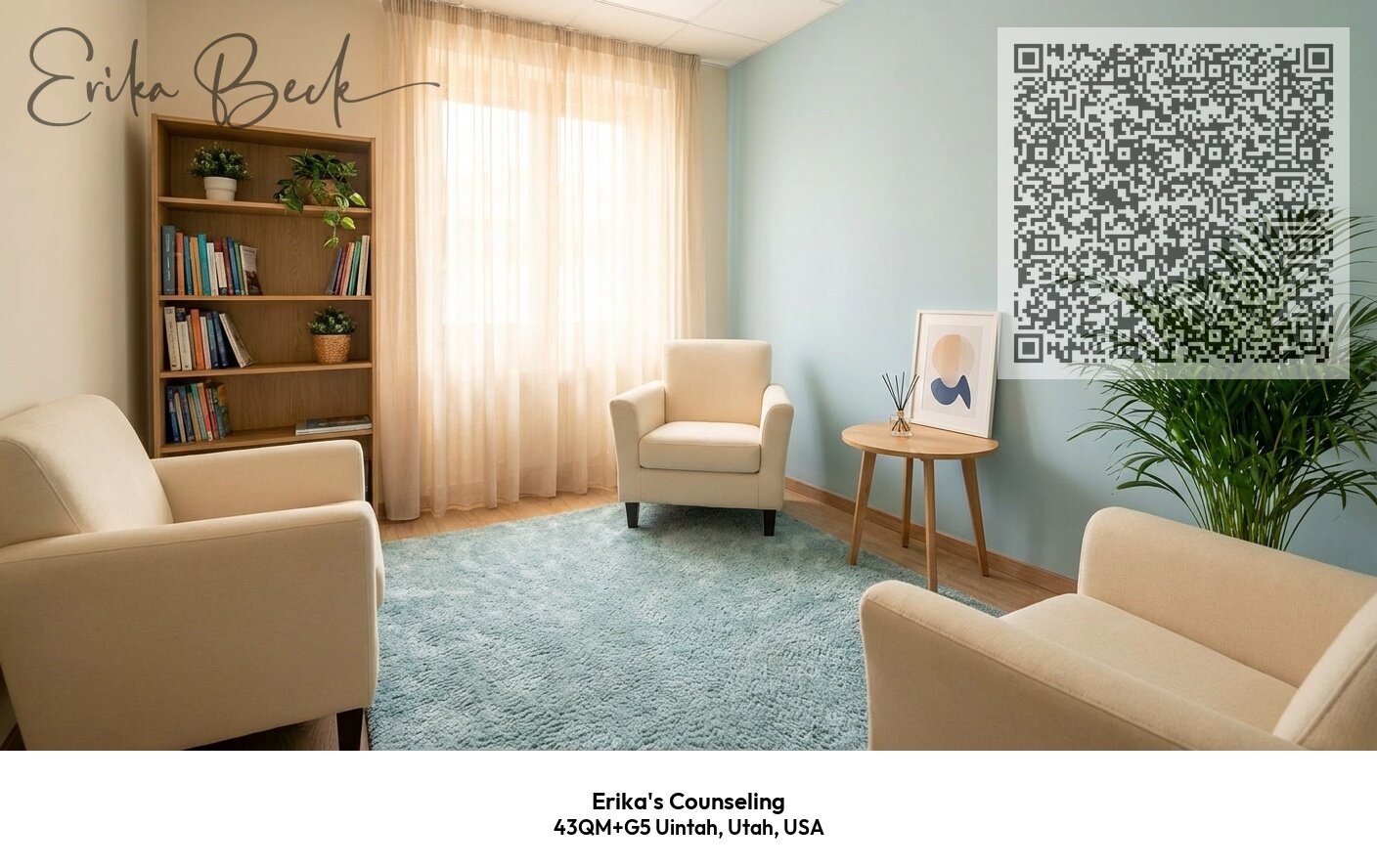
For local visitors, the matching public listing places Erika's Counseling at 6696 South 2500 East Ste 2A in Uintah, Utah.
The practice focuses on creating a supportive, nonjudgmental setting where women can build coping skills, regulate emotions, and work through hard seasons with practical guidance.
If you are looking for a Uintah-based counseling office while also needing therapy licensed for Utah or Idaho, the site and listing provide a clear local starting point.
To ask about a free 15-minute consult, call 208-593-6137 or visit https://www.erikascounseling.com/.
For map directions and current listing hours, see https://www.google.com/maps/place/Erika's+Counseling/@41.138781,-111.9171075,17z/data=!3m1!4b1!4m6!3m5!1s0x875307cd5b7b0049:0x18b6b07ca7fe6b35!8m2!3d41.138781!4d-111.9171075!16s%2Fg%2F11mzyjzcs4.
Popular Questions About Erika's Counseling
What does Erika's Counseling offer?
Erika's Counseling offers counseling and coaching for women. The site highlights support for anxiety, depression, trauma, grief and loss, burnout, chronic stress, self-esteem, body image, boundaries, communication, and life transitions.Who leads the practice?
The website identifies Erika Beck, LCSW, as the therapist behind the practice.What therapy approaches are mentioned on the site?
The official site mentions Cognitive Behavioral Therapy (CBT), Exposure and Response Prevention (ERP), Acceptance and Commitment Therapy (ACT), Accelerated Resolution Therapy (ART), Internal Family Systems (IFS), Polyvagal Theory, mindfulness-based therapy, and compassion-focused therapy.Who is this practice designed to serve?
The site is written primarily for women, and it also mentions support for moms as well as anxiety coaching for teen and tween girls and their parents.Where can Erika's Counseling provide therapy?
The website says Erika Beck is licensed to provide therapy in Utah and Idaho.What does the site say about counseling versus coaching?
The counseling-versus-coaching page explains that therapy is for mental health treatment and can address past, present, and future concerns, while coaching is presented as forward-focused support for problem-solving, values, goals, and growth from a more stable starting point.Where is the Uintah office and what hours are listed?
The public listing shows Erika's Counseling at 6696 South 2500 East Ste 2A, Uintah, UT 84405. Listed hours are Tuesday through Thursday from 9:00 AM to 4:00 PM, with Sunday, Monday, Friday, and Saturday marked closed.How can I contact Erika's Counseling?
Call tel:+12085936137, email [email protected], visit https://www.erikascounseling.com/, or follow https://www.instagram.com/erikabeckcoaching/.Landmarks Near Uintah, UT
Uintah City Park — Uintah City describes this as a central community park with trees, sports courts, a playground, a baseball field, and picnic space. If you are near the park or city center, Erika's Counseling’s Uintah office is a practical local reference point for directions.Mouth of Weber Canyon — Uintah City says the community sits at the mouth of Weber Canyon. If you travel the canyon corridor regularly, the listed Uintah office provides a clear nearby therapy location reference.
Weber River — The city history page notes that Uintah is bordered by the Weber River on the south and west. If you use the river side of town as a local point of reference, the public map listing can help with routing to the office.
Uintah Bench — Uintah City notes the Uintah Bench to the north of town. If you are coming from bench-area neighborhoods and roads, the practice’s Uintah address gives you a simple local destination to work from.
Wasatch Mountains — The city history page places the Wasatch Mountains to the east of Uintah. If you live along the foothill side of the area, Erika's Counseling remains part of that same local Uintah setting.
Historic 25th Street — Visit Ogden describes Historic 25th Street as a major destination for shops, events, art strolls, and local activity. If you split time between Uintah and downtown Ogden, the Uintah office remains within the same broader local area.
Ogden Union Station — Ogden’s Union Station and museum district remains one of the area’s best-known landmarks. If you use Union Station or west downtown Ogden as a directional anchor, Erika's Counseling’s Uintah address is a useful nearby point of reference.
Hill Aerospace Museum — The official museum site presents Hill Aerospace Museum as a major visitor destination with free admission and extensive aircraft exhibits. If you commute through the Hill AFB corridor, the Uintah office is a helpful local therapy reference for route planning.
Ogden Nature Center — The Ogden Nature Center is a well-known education and wildlife destination in Ogden. If you are near west Ogden or use the nature center area as a landmark, Erika's Counseling’s Uintah location is still a recognizable nearby option.